

Flat roof repair tips

Start by using scissors to cut a patch of TPO membrane for a TPO roof repair or modified bitumen membrane for a modified bitumen roof.
Be sure to verify what type of flat roof you are working on prior to starting a flat roof repair . A “flat” roof isn’t actually flat, but has a subtle pitch to allow drainage.
The most common types of flat roof are:
- Built-up roofing (BUR) – This type of roof consists of layers of asphaltic sheets (or plies) that are mopped down with coal-tar pitch and then covered with gravel.
- Ethylene Diene Propylene Monomer (EPDM) – EPDM is a synthetic rubber membrane that can be ballasted (weighed down with smooth rocks), fully adhered or mechanically fastened.
- Thermoplastic Olefin (TPO) – TPO is a synthetic membrane roof that can be fully adhered or mechanically fastened
- Polyvinyl Chloride (PVC) – Also known as vinyl roofing, PVC is derived from fossil fuels and salt.
- Modified Bitumen – This type of roofing is manufactured from asphalt and a variety of solvents and modifiers to enhance performance.
Before beginning a flat roof repair, identify the source of any leaks.
Unfortunately an, easy-to-see hole directly above the leak in the ceiling is rarely the case. Often, the water is getting in several feet or more from the location of the lead.
If the hole, blister, or otherwise damaged section isn’t apparent, look at nearby details, such as a chimney, wall flashing, window or door flashing, roof vents or other pipe/conduit penetrations. If the leak is being caused by damaged or deteriorated roof flashing, you may have to consult someone who specializes in roof repairs to help diagnose and repair the problem.
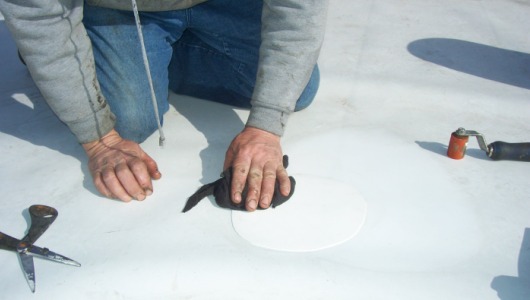
Using a NAPTHA-based cleaner, clean the area of roof to be patched, as well as the patch.
Problem: The flat roof repair is on TPO or Modified Bitumen.
Solution
Start by using scissors to cut a patch of TPO membrane for a TPO roof repair or modified bitumen membrane for a modified bitumen roof. Manufacturers recommend the patch be 3 inches larger than the hole. The rest of the repair is identical for both roofing types.
Using a NAPTHA-based cleaner, clean the area of roof to be patched, as well as the patch itself. Allow both to dry.

Place the patch over the hole and use a commercial grade heat gun to heat the underside of the patch, while simultaneously adhering the patch with a roller.
Place the patch over the hole and use a commercial grade heat gun to heat the underside of the patch, while simultaneously adhering the patch with a roller. Heat guns used for wallpaper removal are not adequate for this application.
The recommended setting to “weld” the TPO membrane is #8, or 1,200 degrees F. When the patch is fully adhered, the repair is complete.

If the roof you are repairing is a ballasted roof, carefully scrape the rocks away from the area to be patched.
Problem: The flat roof repair is on EPDM roofing.
Solution
Many EPDM roofs are covered with smooth rocks known as ballast. The rocks hold the membrane down. If the roof you are repairing is a ballasted roof, carefully scrape the rocks away from the area to be patched. Typically, you’ll have done this to locate the leak in the first place.

Clean the membrane until it’s “jet black” using a NAPTHA-based cleaner.
With the area exposed, clean the membrane until it’s “jet black” using a NAPTHA-based cleaner and allow it to dry completely.

Apply a coat of single-ply roofing primer with a scrubbing pad, such as Scotch Brite and allow it to dry until the surface becomes tacky, 2 to 3 minutes
Once dry, apply a coat of single-ply roofing primer with a scrubbing pad, such as Scotch Brite, and allow it to dry until the surface becomes tacky – 2-3 minutes.
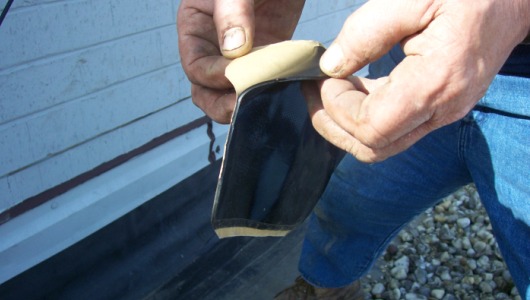
Cut a patch of EPDM pressure-sensitive tape about 3 inches larger than the hole on all sides.
Cut a patch of EPDM pressure-sensitive tape about 3 inches larger than the hole on all sides.
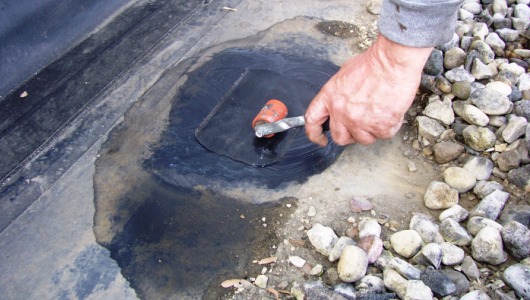
Adhere the patch to the primed area using a roller, and roll it in two directions perpendicular to each other
Adhere the patch to the primed area using a roller, and roll it in two directions that are perpendicular to each other.

After about 60 minutes, caulk the edge of the patch with a rubber-based caulk and cover area with the ballast.
After about 60 minutes, caulk the edge of the patch with a rubber-based caulk and then cover area with the ballast.
Problem: You’re repairing BUR or Modified Bitumen roofing using cold process cement.
Solution
Cold Process Cement is a multi-purpose, fast setting asphalt cement that can be used on any asphalt-based roofing. Apply the Cold Process Cement directly over the hole in the roof. Immediately place a piece of reinforcing mesh over the cement, and then apply a second layer of cement. Allow it to dry.
—By Bruce Webb
